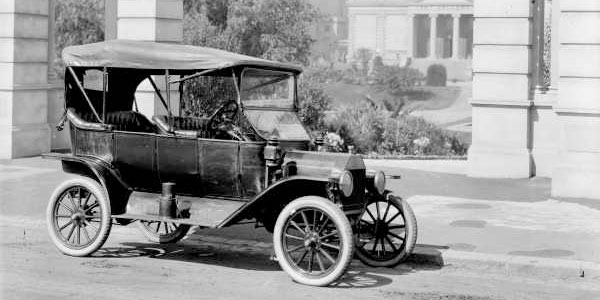
| September 20, 2015 You might love your car, but is there any money to be made in the auto industry? Recent history hasn't been pretty. The 2008 crash was hard on nearly every industry, with our banking system needing to be bailed out to survive. But if you think back to that time, the auto industry got bailed out as well. That's not a surprise when you look at the chart below. Auto sales effectively fell of a cliff back in 2008. Yet, as you can see, sales are now recovering. With this recovery in mind, I paid close attention to one of the auto industry's biggest events this week: The Frankfurt Auto show. Whether you're an investor on the hunt for opportunities or just a car nut, you'll want to pay attention to what was unveiled this week ... because BIG changes are on the way. to profit off its untapped potential. To view our free video on the subject, simply click here. Detroit is rolling again To illustrate how good the auto industry is suddenly doing, just take one look at Detroit. Known in recent years for rows of abandoned houses and its municipal bankruptcy, Detroit has undergone a dramatic recovery. After unemployment in metro Detroit peaked at 16% in 2009, it's just 5.8% today. Car sales are to thank. Through August, car sales are trending to their highest level since 2001. And it's not just the number of cars being sold on the rise ... people are buying more expensive cars filled with ever more impressive technology. The size of auto loans has increased 15% in the past five years as consumers opt for upgrades like tech packages. The future isn't in Detroit Yet, looking at the Frankfurt Auto Show, car companies aren't chasing new ideas from Detroit. Instead, they all seem to have Silicon Valley envy. I'm not going to talk about self-driving cars today ... although Mercedes-Benz did unveil a self-driving limo service to compete with Uber at the show. Instead, the envy coming out of Frankfurt was all targeted at upstart carmaker Tesla's electric cars. Porsche announced its new Mission E, a sporty electric car turning out more than 600 horsepower that could be available within 3 years. It'll zoom 0-60 in just 3.5 seconds. Audi announced its own electric SUV to compete with the SUV Tesla begins shipping this month. Then there are reports that Mercedes has its own Tesla competitor ready to unveil, though it hasn't been officially announced as of this writing. You know what they say ... imitation is the sincerest form of flattery. This is about to become a huge market Right now, electric cars are a niche market, and you'll notice that all those Tesla competitors listed above are battling for the luxury end. It'd be easy to dismiss electric cars as merely play toys for the environmentally conscious elite; until recently I was skeptical of their success myself. However, a couple very important points changed my mind. Companies aren't just copying Tesla to attract the environmentally conscious; they're copying Tesla because it makes the best luxury cars! When Consumer Reports rated Tesla's newest P85D sedan, it literally broke their rating system. The car scored 103 on a 100-point scale. As Consumer Reports noted, the new Tesla car did "better in our tests than any other car ever has, earning a perfect road-test score." Second, while Tesla is targeting the luxury car market segment today, that strategy is about to change. Tesla is releasing a new "Model 3" that's expected to retail starting at $35,000. That sticker price is still more expensive than many cars, but the cost of owning a Tesla drops when factoring not paying for gas fill-ups and other savings. Thanks to the cheaper Model 3, Tesla founder and visionary Elon Musk believes his company can ship 500,000 electric cars a year by 2020. The big deal with electric cars A half million cars a year might still not sound like much ... the automobile market is huge. But, consider the following: Tesla didn't hit 10,000 car sales a year until 2013. That means it'll take the company just seven years to potentially reach its 500,000 sales target. The Ford Model T first hit 10,000 sales in 1909. The company ended up shipping 500,000 cars a year... seven years later. It's said that history doesn't repeat, but it sure does rhyme. Thinking back to the early 20th century ... the Model T's main competition was actually electric cars themselves. The Model T won because its massive production created economies of scale and manufacturing innovations made it substantially cheaper to build. Along the way it overcame several technological limitations (Ford's wife famously refused to give up her electric car because it was more reliable). Today, electric cars suffer from their own limitations ... the largest of which is that the batteries they use to store power (and move the car) are expensive and have limited range. However, the massive factory Tesla's building will create its own scale for the battery industry, decreasing costs by up to 30%. That's just the beginning of the story. And it's just one of the many possible futures David Gardner saw in Tesla when he recommended it to members of his Rule Breakers investing service back in 2011. As he mentioned in a recent episode of his podcast (which I encourage all of you to listen to), he's looking for companies with many futures ... many possible happy outcomes. For the record, his recommendation of Tesla is up 733.9%, as of Friday morning. In this one possible future for Tesla, battery costs will decline, then become useful in industries like storing electricity from power plants, which further boosts demand and encourages more manufacturing innovation to drop their price further. It might sound strange to say, but the same forces that killed the electric car 100 years ago may now be driving its rebirth today. In business, this self-propagating kind of system is known as a "virtuous cycle," and it's very powerful. Watch carefully what happened in Frankfurt this week. Big things start small. Until next week,
Eric Bleeker, CFA P.S. If you're excited about the future of cars, I took a recent research trip to Silicon Valley and was able to see first hand some amazing technology that even has Warren Buffett sweating! Our analysts crunched the numbers and believe this technology will hit the market much faster than expected, which leaves a limited window to profit off its untapped potential. To view our free video on the subject, simply click here.
Having trouble seeing this email? View on Web We work fervently, feverishly, and Foolishly to make sure all the facts and figures we publish in our emails are 100% accurate and up to date. David Gardner owns shares of Ford and Tesla Motors. Eric Bleeker owns shares of Tesla Motors. The Motley Fool owns shares of Tesla Motors. Returns as of September 18, 2015. To ensure you receive the latest and greatest from us, add Fool@foolsubs.com to your address book. Don't want any more emails? No problem... unsubscribe now, or change your email preferences here. This is a promotional message from The Motley Fool | 2000 Duke St. | Alexandria, VA 22314
Copyright ©1995-2015 The Motley Fool. All rights reserved. Legal Information.
| 



0 comments:
Post a Comment